
A Back To School Special
Teaching 101 at Edison Junior High

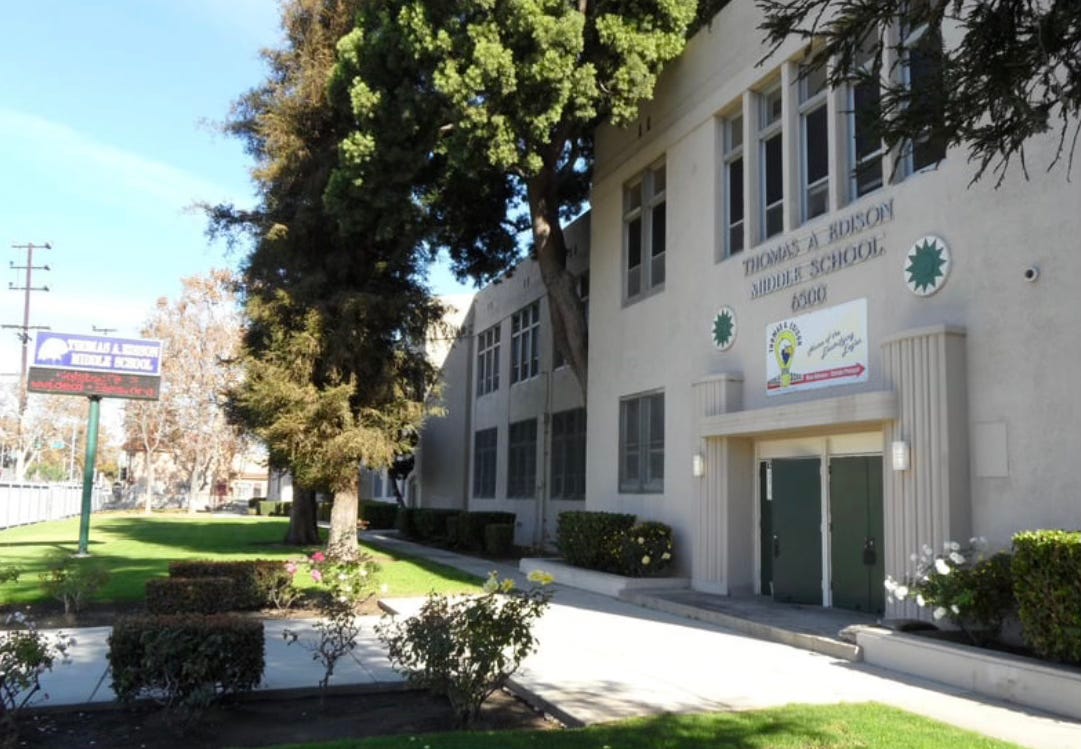
I retired from teaching a year ago after 35 years. I’m glad I had a long run and I’m also glad it’s over. I paid for a decades-long immersive experience with much labor and am just now able to begin processing it. I knew when I started to scribble for Substack that my teaching experiences would provide ample subject matter, easily enough to sustain more than one piece, possibly several. The range is there: teaching is many things - from a hard-wired human attribute to a political-football occupation. I kept my mouth shut at faculty meetings to hasten their conclusion for years, but those days are over. So, fellow teachers, where to begin?
I had worked an entry-level job in a big corporation after college, but climbing the ladder there wasn’t a thrilling prospect. Teaching seemed a better fit, probably because by then I’d spent most of my life as a student and benefited from some excellent practitioners along the way. I also had a couple cool roomies who were giving it a try. So I bailed on corporate life and started working as a substitute teacher as soon as I could. I kept at it for a couple years while managing to support myself, take a class or two, and fall hard for a beautiful woman. All of a sudden I needed decent work for the foreseeable future. I’d harbored some notions of working as an illustrator or taking a stab at the lower rungs of the film biz, but wanted something with a promise of stability, something befitting a married man hoping for a family, complete with health insurance and job security.
My teaching pals managed to get full-time classroom jobs on ‘intern’ status, without having done student-teaching. They’d both been hired by the Los Angeles Unified School District as it responded to an inner-city enrollment surge that, by the mid-80s, had forced many schools onto a ‘year-round’ schedule. Anyone with a BA, adequate enthusiasm and apparent aptitude stood a good chance of landing a spot without lumbering through a teacher-prep program. Having spent over a year as a sub, including a couple long-term gigs (one lasted an entire semester), I thought I could easily follow their lead. So failing to make that cut was a humbling experience, and I had to finish my training the old-fashioned way instead. I kept subbing while I got the classes out of the way and then did a semester (fall 1988) of student teaching in English and social studies.
By the early summer of 1989 I’d finished prepping and my wife was pregnant. I needed to start working ASAP and began shopping myself around. LAUSD, then as now a behemoth, offered the best prospects, particularly since it had so many year-around schools. Subbing for them taught me where the jobs were: south central LA. And Edison Junior High, at 65th and Hooper, was smack in the middle of it.
I got an interview on the last day of June and was offered a spot. I took-over four 9th-grade English and two reading classes a week later, a couple days into the new school year, and went on to teach at Edison for most of the ‘90s. By the time I left exactly 10 years later I was a father of three, a homeowner (had begun work on my ‘Mr Fixit’ degree), and was convinced that teaching would be it for the rest of my working-stiff life. At that point it was time to move on and I headed off to live and teach in a very different place. I felt lucky to have gotten off to a decent start and knew I still had things to learn, both personally and professionally. I just didn’t realize how much.
Where I had been was suitably uncomfortable in many ways. Because of the year-around schedule the school day started at 7:30 AM and lasted until 3:20 PM. We had long days because we actually had fewer of them; the school was divided up into three multi-grade level groups of students and teachers, with two of them on campus at a time while the other was ‘off track’ for a couple months. This arrangement maximized the use of the facilities but also limited the instructional year to 165 days, three weeks less than a typical school year. We had to stretch the days we had, since our ‘year-round’ year was actually shorter than a regular one.
Each one began with a serious hike from the parking lot to the main office - Edison’s large, venerable main building is reputed to have the longest hallways of any school in LA. Sign-in ten minutes early or you’re late - a new teacher on probationary status can’t take such matters lightly, so I had to become something I naturally wasn’t: a morning person. In my case that also meant getting out the front door at least an hour early, since 28 miles of sticky LA traffic stood between me and the main office.
The basic logistics of schooling are complex, and size amplifies every organizational burden. At Edison everything was big: with a total enrollment of around 2400 students, 1600 on campus at a time, the school was operating at maximum capacity. Just feeding everyone was a major accomplishment. The very big cafeteria was not big enough, so we teachers had it to ourselves (separate from the smoking lounge, of course). The kids ate California style, outside under massive awnings 800 at a time, during dual, separate break and lunch periods. When finished they could goof-off a bit on the ‘blacktop’ - it covered the entire grounds, the only green grass being off-limits out front - and in summer the place resembled a huge frying pan. But Edison kids were nothing if not resourceful. They wandered around, played catch, tag, flirted or gossiped - and supplemented cafeteria offerings with a unique taste treat: a repugnant mix of student-store corn-nuts doused in spicy pickle juice. I still get nauseous just thinking about it.
My shiny new credential qualified me to teach English, social studies and art. English was the entry ticket, the subject area of greatest need, but no comprehensive guide landed in my lap. My student teaching and sub experience were a plus, yet still left me with a puny skill-set. I did quickly locate the book room, and fetched available stuff: class sets of a reading anthology, writing workbook, grammar guide. No single thing I got there was sufficient to meet my students’ needs; they were generally a few years behind their suburban peers and at least half didn’t speak English at home. It was an ethnically mixed bunch - mostly but not exclusively Hispanic - who would’ve done better with a teacher who had more to offer, but were stuck with my rookie shortcomings instead. I had as much as I could handle, and in that first year was exposed to a wide range of teenage circumstance: the 8th grader bound for the district’s pregnant-girl-school; the boy stumped and stopped short by a word he couldn’t pronounce sitting next to the girl who wove a witty short story out of the same vocabulary list; the girl whose name I could barely spell or pronounce (‘Xochitl’); the kid whose older siblings had been killed by the Khmer Rouge.
I was 29 and had managed to gather information, form ideas and opinions, earn a BA, work, pay bills, fall in love. But I’d done all that in a lighter weight class. Now I was in the ring with much riding on an uncertain outcome, going toe-to-toe against powerful forces. Teaching - English in particular - is demanding in many ways, and inner-city teaching adds extra weight to the load, so the attrition rate is higher, but I had too much at stake to pad that number. Still, what I wanted most was to teach art, a more enjoyable, somewhat less demanding gig. That was still years down the road. In the meanwhile I had no choice but to ‘lean in’.
Being on ‘B Track,’ though, I caught a bit of a break. The group’s school year started on July 1 but took two months off at the end of August, returning for the second half of the semester near the end of October. When I went ‘off-track’ I was able to sub a bit for some of my new ‘on-track’ colleagues, and also take time to catch my breath and get the measure of the starter home my in-laws had generously helped us buy - homeownership was even more of a new experience for me than a serious job. Five weeks after I went back on-track my first parent-conference night kept me on campus late the last night of November. Halfway through my classroom phone rang. An incoming call from my wife was patched-in: because she was full-term, efforts to induce our first-born’s debut were set to begin Saturday. When I hung up I knew I’d waited a lifetime for that call.
When I reflect on my time at Edison, some odd bits stand out, randomly and well down the road from my starting point. I can’t remember exactly when I learned that my late mother, gone since I was 10, had attended Edison in seventh and eighth grades, in 1940-41. That was almost fifty years before I showed up; she later graduated from LA’s Washington High in 1945. I learned about her time at Edison by stumbling on an old report card among some random keepsakes while visiting my dad in Nebraska. It didn’t strike me with tremendous emotional force, but it was impossible to forget. Of course, there wasn’t any trace of her there except within me, and sentimentality about such things washes away quite completely in places where the cast consistently changes and there is always so much work to do. But that tiny keepsake rested comfortably in a mental pocket, an emotional prop for the daily grind.
That grind was carried out in constant awareness that the school and its neighborhood had undergone profound transformation. Before the war the city was younger, spread-out, its famously far-flung fringes still semi-rural. After the war bean fields became vast housing tracts, and levels of prosperity previously just beyond reach put a car in every new suburban driveway. But by the early ‘80s the biggest employers near Edison - GM, Goodyear, Firestone - were closing up their huge factories and heading for the outskirts (or different states or countries). The neighborhoods they left behind fell into neglect and ghettoization. When I got there in 1989 Edison’s student body, once mostly white, then mostly black, was mostly Hispanic - and by a wide margin. The neighborhood, an unremarkable middle ground between downtown and the port, had grown shabby and impoverished.
For those that lived there it could also be dangerous. That point was driven home by a mouthy student. ‘Gabby’ was loud, moody, unmotivated, often disruptive - a ‘hot mess’ if ever there was one. An apprentice such as I typically struggles to engage a kid like that; their havoc throws you off your game. But she and I were stuck with each other, much to our mutual dismay. When I complained to a veteran teacher pal about her I got some backstory: she’d seen her sister shot to death in the front yard a couple years before, when she was in 7th grade. That wasn’t something I could ignore or forget. Finding out changed my perspective, and as I cut her a bit more slack her behavior and classwork improved. Her experience wasn’t typical, but she had more company at Edison than she would have in most other schools.
After three years of English I finally got a chance to teach art. Since I hadn’t student-taught the subject - my undergrad major - I was starting from scratch, but tried to make up in enthusiasm what I lacked in experience and savvy. That process kept me on my toes for a very long time, even after I’d moved on to other schools. But a shy loner left me with a singular lesson that landed with a thud on my classroom floor in the mid-90s, and the memory of it stuck. Whether I handled it appropriately may be debatable, but I’d quickly thought it over at the time and saw no other option.
It was a mild, quiet summer afternoon. My classes were in a shady upstairs room. Enrollment for that period was a bit low, so there were open seats at the tables in the back. I wandered among the kids while they quietly worked on a drawing and circled behind the last row where a tall, shy kid with wavy hair was sitting by himself. As I turned to stroll back toward the front I heard a distinct thump-clank and looked down to see a large, folded buck knife under his chair. It had fallen out of his pocket. He froze as I picked it up. We exchanged a glance. He was embarrassed and nervous, though none of the other kids seemed to notice what had happened. I kept the knife and put it in my desk, careful to make sure no one saw it.
Earlier that year a terrible incident at another LAUSD school had forced a new district-wide policy: ‘zero tolerance’ - automatic expulsion - for any student caught with a weapon. The city was in the throes of a bloody, historic surge in its homicide rate, and district officials had no other recourse. So the knife I’d picked-up was something to think about. When class was over I told him to come back to my room after school. He showed up and looked nervous. The gravity of the situation weighed heavily as I explained the policy and told him what might happen - though he probably knew it all already. I wasn’t quite ready to take the matter further but the apparently inevitable outcome was within sight. Then he explained why he had it: he’d been harassed by gang-bangers on his way home from school, so his dad had given it to him for self-defense.
His explanation took me aback. In the hour or so I’d had to mull it over I’d concluded that the kid was unlikely to use the knife on campus or have some bloody scheme in mind. But unless I carried out the policy my own position was tenuous as well: if it became known that I’d failed to report the incident and turn the knife over to the dean my job would be on the line. Now the ball was in my court. I didn’t want to keep the knife, or turn it in and say I’d stumbled across it. Seeing the boy expelled because the damn thing fell out of his pocket at the wrong moment now seemed wrong. So I handed it back to him and told him not to bring it back. I knew he’d likely ignore that. But, at face value, his story boiled down to having it because he wanted to get from home to school and back again. The story wasn’t impossible to check, but I wanted to resolve it all immediately. So I had to choose whether to believe him or not. The hand-over was nerve wracking, but he made it through the semester, and after that I never saw him again.
Tim, it is simply astonishing how much we have in common and not just because we have parallel careers. Nicely conveyed here. And I hope you continue. I started a sort of Look Back memoir that has fallen by the wayside but you inspire me to get back to it. You certainly have taken more time to discuss the context of it all. Nicely done. Glad we have crossed paths!